Prototyping That Saves You Money: Why Fast Iteration Matters More Than Ever
Every delay, redesign, or production mistake has one thing in common: It could’ve been caught with the right prototype.
Every product starts with an idea. The companies that succeed are the ones that turn that idea into something they can hold, test, and improve long before production begins. That’s where prototyping earns its keep.
For teams working under tight timelines and tighter budgets, the right prototype can prevent expensive mistakes, accelerate approvals, and keep a project moving when the stakes are high. At MBS 3D Solutions, we work with companies who need more than a model—they need a partner who understands the realities of product development.
Why Companies Prototype
Most teams reach for a prototype at the same moment: when the design looks good on a screen but still needs to prove itself in the real world. That’s when questions start stacking up.
Does this design actually work?
Will it assemble cleanly and consistently?
Does it feel right in the hand?
Can we test multiple versions quickly?
A prototype answers all of these before you spend real money on production. It’s the fastest way to validate assumptions and uncover issues that CAD can’t show.
Here’s a quick look at how the prototyping process fits into the full product‑development timeline.
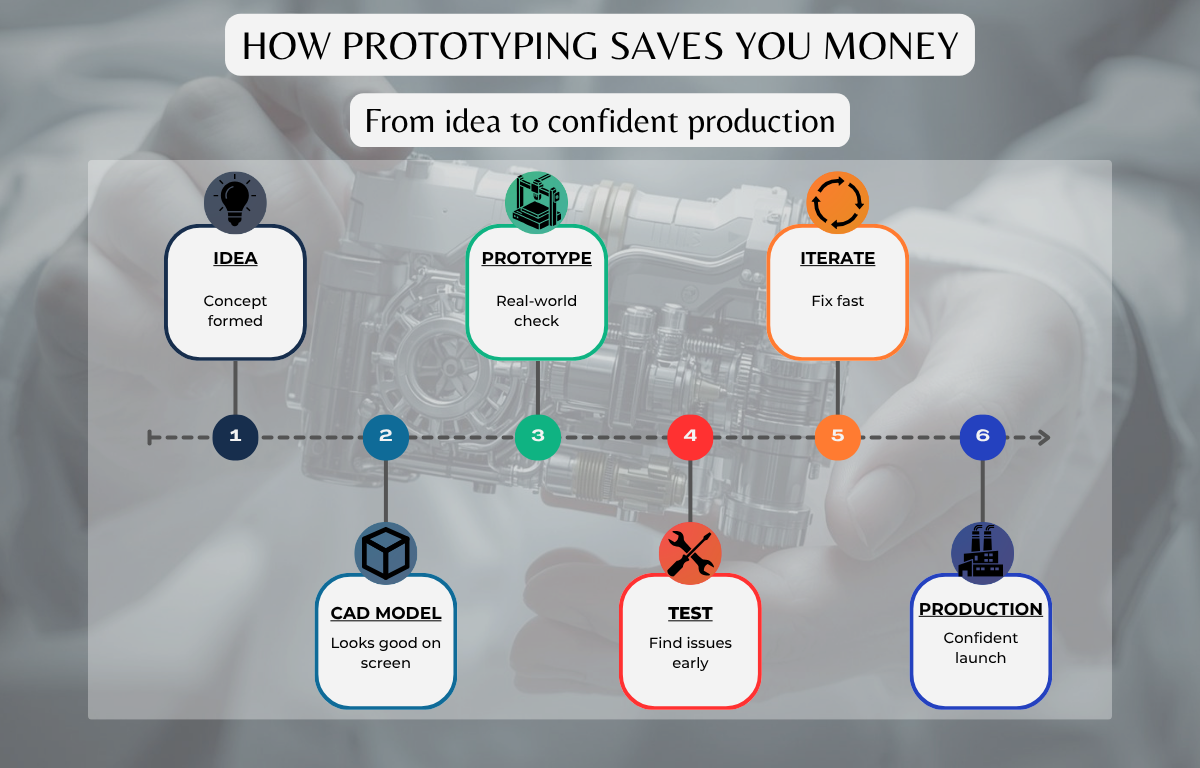
A visual overview of the prototyping process—from idea to production—showing how fast iteration reduces costs and prevents design mistakes.
The Hidden Costs of Skipping Prototyping
Fixing a design after production starts is expensive. Teams that skip prototyping usually do it to save time or money—only to lose both later.
Common failure points we see:
A tolerance stack-up that looked fine in CAD but fails during assembly
A part that feels awkward or unintuitive once it’s in hand
A design that can’t be manufactured without major changes
A feature that works in theory but not in real-world use
A prototype exposes these issues early, when they’re cheap to fix.
What Fast Prototyping Actually Solves
Speed isn’t just about getting a part in hand quickly. It’s about enabling rapid iteration, which is where real progress happens.
Fast prototyping helps teams:
Compare multiple design versions side by side
Test ergonomics, fit, and function
Validate manufacturability before committing to production
Present a physical model to stakeholders or investors
Move from concept to production with fewer surprises
When you can test, adjust, and retest in days—not weeks—you make better decisions and avoid costly rework.
Materials & Capabilities That Support Real Testing
We produce prototypes in engineering‑grade materials that behave like production parts. Some of those include:
Nylon for strength and durability
PETG for impact resistance
TPU for flexible components
PLA for fast, low‑cost iterations
Because prototype materials cover a wide range of performance characteristics and often vary by industry, these examples highlight the core options most teams rely on for functional testing. This ensures your prototype isn’t just a visual model—it’s something you can test, handle, and evaluate.
How MBS 3D Solutions Fits Into Your Workflow
Companies come to us because they need prototypes that do more than look good. They need parts that behave like the real thing.
We specialize in:
Functional prototypes for real-world testing
Tight tolerances for engineering‑grade parts
Rapid turnaround for teams on deadlines
Multiple iterations to refine design quickly
Small‑batch runs for early testing or pilot production
NDA‑friendly workflows for confidential projects
Whether you’re refining a single component or validating a full assembly, we help you move from concept to production with confidence.
A Real‑World Example
A product team came to us with a part that looked perfect in CAD but didn’t assemble cleanly in the real world. We produced a functional prototype that revealed a subtle alignment issue. After two quick iterations, the design was corrected before they committed to production—saving weeks of delay and thousands in rework.
The Bottom Line
Prototyping isn’t an extra step. It’s the step that protects your timeline, your budget, and your product’s success.
If you’re designing a part that needs to work the first time, a prototype is the smartest investment you can make.
Ready to move your design forward?
Get a Free Quote and start your next iteration with confidence.
Edited by Breakey Acres Proofreading